

Henrik Aulbach est un rédacteur santé expérimenté avec plus de 10 ans d’expérience, expert en principes actifs végétaux et en culture, cofondateur, auteur et rédacteur indépendant dans le domaine de la santé depuis 2020.
Découvrez ici plus d’informations sur cet auteur.

Souci dans la médecine monastique
Tout sur le souci

Hildegards Tipp:
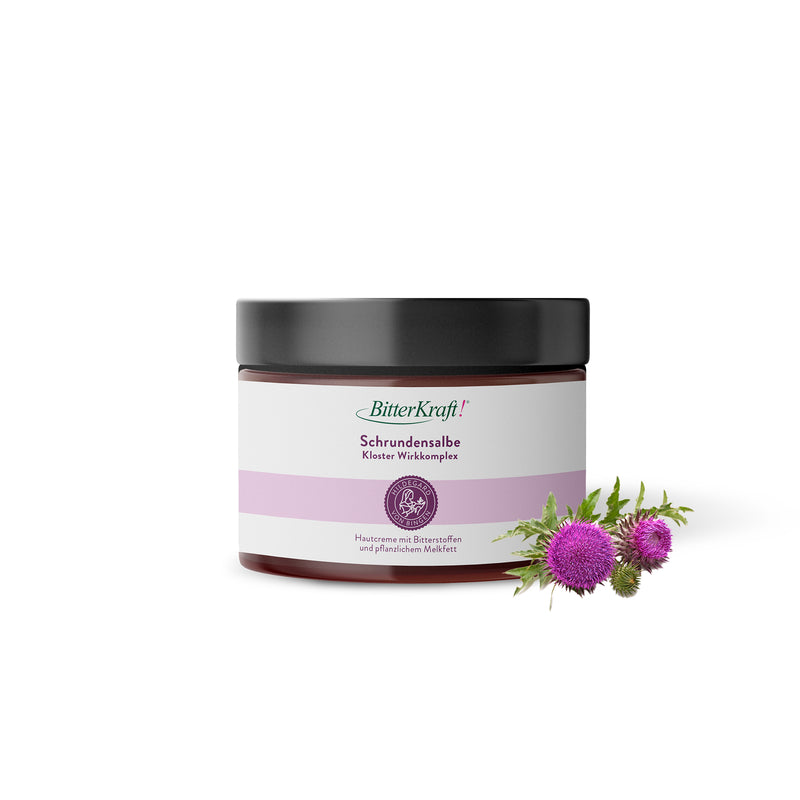
- Pflegende Salbe für raue und rissige Haut
- Rezeptur auf Basis von 800 Jahren Klosterwissen
- Bitterkraft – der Pionier seit 1996 von 4.000 Heilpraktikern verwendet!
- Beste Naturheilkunde: Bio & vegan
Occurrence
The marigold (Calendula officinalis) is a plant species of the Asteraceae family. It has long been used as a medicinal plant, which is why many still rely on certain parts of the marigold today.
Where the plant originally comes from is still unknown. It probably originated in the Mediterranean region. It is now found throughout Europe, both cultivated and as a wild plant. The marigold is undemanding and requires little from its substrate. It prefers rubble and nutrient-rich loose soils to thrive.
Ingredients
Flavonoids are the most important ingredients of the marigold, especially quercetin and isorhamnetin glycosides. They are present at concentrations of up to one percent. Flavonoids are roughly speaking the pigments of plants. Some doctors therefore recommend that one should make their diet as rich in flavonoids as possible.
Essential oils are also found in the Asteraceae, but in quite low amounts, which is why corresponding preparations are hard to find.
Polysaccharides (larger sugars or carbohydrates) are still well represented with up to 15% content. It becomes even more interesting with the achenes (fruits of the marigold). These contain up to 25% fat, with the rare fatty acid calendic acid making up a large part of it.
Mode of action
As a cultivated plant, the marigold has long been part of the European landscape. But it was only in the Middle Ages that Hildegard von Bingen drew attention to its beneficial properties. In the Physica, the universal scholar described a plant that supports digestive problems and helps heal various types of inflammation – the Ringula. This referred to the marigold.
Today, the EU officially states that due to a lack of studies, a medical effect is not sufficiently proven. However, since it has such a long tradition, it is classified as non-harmful to health and can therefore continue to be consumed. The marigold is used in industry for dyes, tea blends, and as a medicinal plant.
When used internally, the Ringula is said to improve menstrual as well as stomach and intestinal complaints. For this, you pluck a few marigold flowers and prepare a tea or tincture from them.
The external use of the medicinal plant is much more common. The marigold helps to close poorly healing wounds, inhibits inflammation, and has virucidal, fungicidal, and antimicrobial effects. It is a common ingredient in wound healing ointments.
Appearance
Typical for the annual marigold are its petals arranged like sun rays. Its appearance has also earned it the popular name "golden flower".
Between June and October, when the sun rises, the marigold offers a fascinating spectacle. Punctually at sunrise, it opens its flowers, which shine in numerous shades of yellow – from yolk yellow to orange-yellow. And as the sun moves along the horizon in the evening, the petals slowly close again. During rain, it does not show its full splendor at all during the flowering period.
Marigold: Frequently Asked Questions
What is marigold good for?
As mentioned above, you can consume marigold. Its fruits contain quite a lot of fat and the plant itself many polysaccharides. However, the taste is said to be quite bitter and peppery.
Marigold is most commonly used as a tincture for external complaints; Hildegard von Bingen, for example, used it for wounds and inflammations.
If you take a marigold preparation orally, it can possibly help with menstrual and stomach pains. However, as already mentioned, the EU does not consider the medical effect sufficiently proven.
In industry, marigold is used, for example, as a decorative herb added to teas or to improve the coloring of cheese. Most people today also buy marigold in the form of teas.
Is marigold the same as calendula?
Yes. The term marigold is the German name for Calendula officinalis. You can therefore use the terms marigold and calendula as synonyms for each other. You can also explore the differences between the two by buying arnica and marigold – as a double pack.
Is arnica the same as marigold?
Arnica (Arnica montana) is a different flower. What it has in common with marigold is that both belong to the Asteraceae family, so they are distant relatives. Due to similar areas of use, arnica and marigold are often used simultaneously.
Marigold, which Hildegard von Bingen called Ringella, was especially used for wound healing. From this, it could be inferred that calendula might have anti-inflammatory, decongestant, and antimicrobial effects. Arnica has been used for the same purpose for centuries. Some consider marigold a milder form of arnica because the latter might be more effective.
When is marigold used?
Most often, a tea made from marigold is drunk for menstrual complaints or stomach pain. Apart from that, in the past, people liked to treat wounds with gauze bandages soaked in marigold extract. Even today, many people apply marigold tinctures when they have minor injuries or inflammations.
Is marigold a weather oracle?
Marigold weather oracle: This keyword is often heard. This is because the marigold opens in the morning. It pays close attention to the weather: If the flowers open before 7 a.m., the day will most likely be very warm and sunny. However, if the flowers are still closed after that time, they follow the marigold weather oracle: The day will probably be cloudy or even rainy.

À propos de l’auteur Henrik Aulbach
Weitere Artikel
Amers amers avant le repas : pourquoi l'ordre est crucial
Amers amers pour l'estomac avant le repas » Selon Hildegard von Bingen ✓ Sans additifs ✓ Fabriqué en Allemagne – En savoir plus maintenant
Smoothies riches en amers : recettes vertes pour bien démarrer la digestion le matin
Smoothies aux amers pour le matin » Selon Hildegarde de Bingen ✓ Végan ✓ Sans additifs – Découvrez les recettes maintenant !
Les recettes d'épeautre de Hildegard von Bingen pour une digestion saine
Recettes d'épeautre de Hildegard von Bingen » Selon Hildegard von Bingen ✓ Sans additifs ✓ Certifié bio – Découvrez maintenant